
RESEARCH_________________
Alameda’s core activity consists of the selection, supervision, and promotion of research projects aligned with its proposition. This provides the basis for our efforts to influence the strategy of activists and organisers, as well as policy-makers.
In our allocation of research funding, we prioritise projects that, despite their possible contribution to such strategy, would not receive adequate support through conventional channels. Research fellows — those who receive funding for research — are expected to develop their projects in close contact with individuals and organisations in Alameda’s network.
Alameda only provides direct funding for research conducted by members of its network.

WE_________
1
prioritise research projects that, though rigorous and relevant, would not receive adequate support through conventional channels.
2
value the quality of research, and its relevance to social struggles, over the quantity of outputs.
3
promote intellectual exchange within our network to establish points of contact between distinct research projects.
4
enable encounters between researchers and political organisations to inform future research projects.
5
provide supervision to research fellows to help them continuously assess the feasibility, relevance, and possible impact of their projects.
Thematic concerns_________
As a response to catastrophe, Alameda is committed to enabling research that reveals the structural causes of contemporary crisis and provides insights as to how they might be overcome. A central theme in our research programme, therefore, is transition (not least as it relates to ecology).
Other initial thematic concerns include: state and society (beyond neoliberalism); protest and political organisation; de-development and the political economy of work; internationalism and empire; subjectivity and rights.
Over time, the thematic concerns of our research programme will come to be defined through our engagement with political organisations, and in accordance with the interests and expertise of members of our network.
CURRENT RESEARCH PROJECTS_________
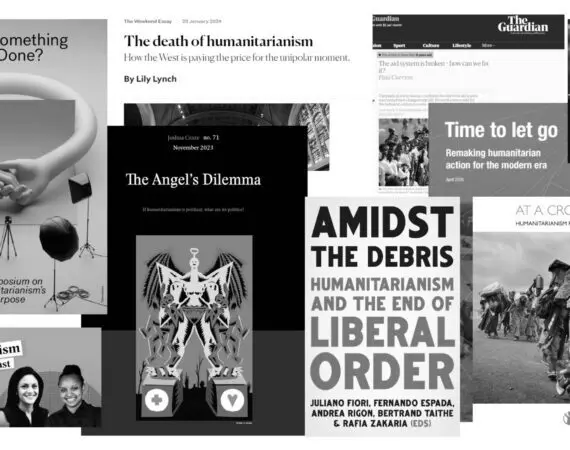
The Limits of Humanitarianism
Politics, crisis and reform in the era of climate change

The Political Economy of Post-Catastrophic Futures
PROJECT | RESEARCHERS |
|---|---|
Disruptive futures: what discourses local groups mobilise against neoliberalism and marginalisation | Felipe Eugênio and Tulio Custódio |
Evaluating institutional approaches to protect workers in the neoliberal economy | Vanessa Oliveira |
The Political Economy of Post-War Reconstruction: Neoliberal Ukraine and the Future of European Transformation | Olena Lyubchenko |
Experiences of transnational workers in the neoliberal economy | Ludmila Abilio |
Socioeconomic crisis and declining democracy in South Africa: a case for building a community of scholars and local leaders | William Shoki, Claire-Anne Lester and Niall Reddy |
Geopolitical conflict and the changing dynamics of production and state power | Ilya Matveev |
Challenges for urban conservation and right to housing in the green transition | Matthew A. Richmond |
The stakes for childcare and children’s rights in the polycrisis | Emily Baughan and Eleanor Davey |
Transnational experiences of periphery and marginalised subjects | Frederico Lyra |
Peasant agriculture and land regeneration in a conflict and polycrisis scenario | Erahsto Felício |
 English (UK)
  Português do Brasil