

Lessons From Lula’s Historic Victory

by Benjamin Fogel

This article Lessons From Lula’s Historic Victory was published by The Nation.

The Brazilian left has stopped the right-wing wave in Latin America. Now it has four years to work out a succession plan.
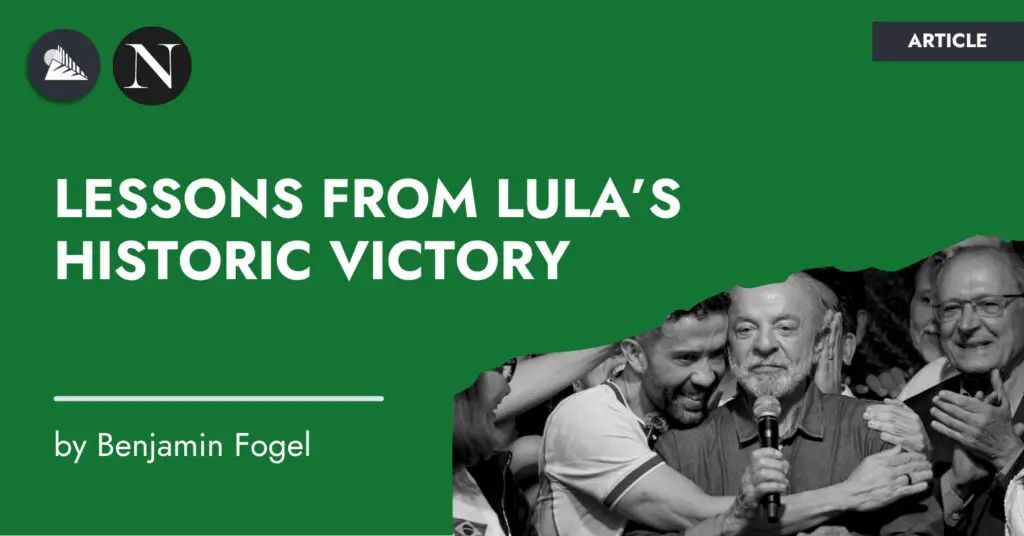
After three of the most intense weeks in the history of Brazilian politics, Luiz Inácio “Lula” da Silva will be president again. Though he lost the first round of the presidential election earlier this month, he went on to win a historic fourth term, finishing 4.4 million votes ahead of Flávio Bolsonaro, the crooked oldest son of former president and convicted coup plotter Jair (the final tally was 51.79 to 48.21 percent). If it wasn’t clear before, it is now: Lula is the greatest popular leader of his generation and one of history’s most gifted politicians.

Flávio has predictably refused to concede, but Lula’s margin of victory was twice as large as his 2022 margin over Jair—and unlike his father in 2022, Flávio does not have the power of the presidency to try to stop Lula from taking office. Some of his closest allies have already fled to Miami, and his brother Eduardo, a former federal deputy who exiled himself to Texas a few years ago, suggested on a podcast last week that Flávio should join him in the United States.

Subscribe to read the full piece Lessons From Lula’s Historic Victory published by The Nation.

Benjamin Fogel

Benjamin Fogel

Benjamin Fogel is a historian of Brazil, editor and journalist from South Africa currently based in London. He has written for publications such as the Guardian, the Independent, the Nation and Al Jazeera. He is also a contributing editor at Jacobin Magazine. With an interest in the comparative analysis of de-development, he has conducted extensive research into anti-corruption politics and organised crime.

RELATED ARTICLES

Brazil in Yet Another End-of-the-World Election

Published in Verso. October 22, 2026 In 2022, on the eve of Brazil’s last presidential election, Brazil’s leading radical publisher Boitempo brought together sociologist Silvia Viana and philosopher Paulo Arantes for a discussion titled “End-of-the-World Elections”. Viana opened by explaining that the…

Putin’s African recruits: the Kenyans lured into Russia’s war

Published in The Observer, this article is part of Alameda’s After Order project October 13, 2026 As the war in Ukraine approaches its sixth winter, Kenyans are among the African nationals recruited to Russian forces, sometimes after being misled that…

Duped and deployed: the Kenyans fighting for Russia

Published in The Slow Newscast (The Observer), this podcast episode is part of Alameda’s After Order project October 6, 2026 Who ends up fighting in a war that isn’t theirs, and how do they get there? The Kenyan government estimates…