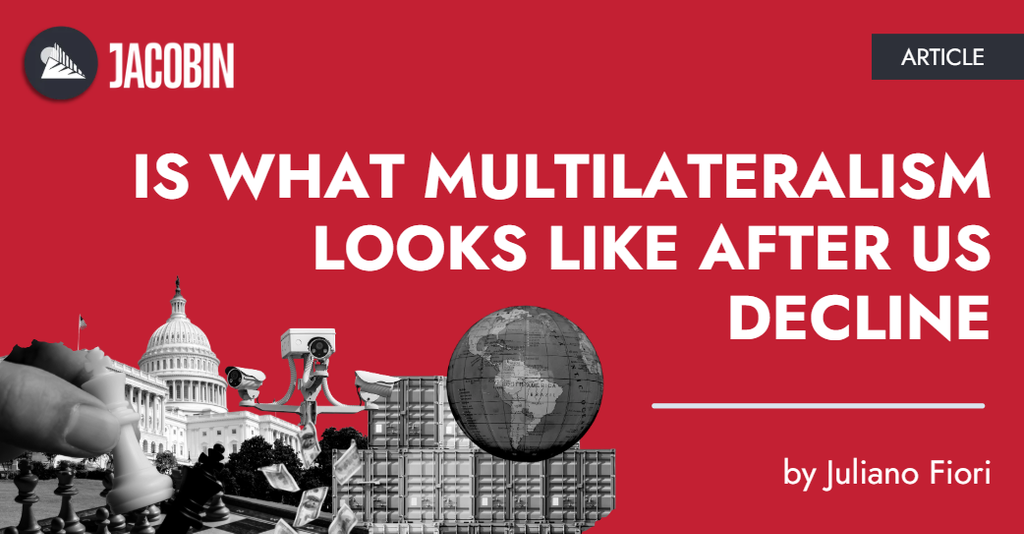
The current crisis in the world order isn’t just about Donald Trump ignoring multilateral institutions. The US has long broken the rules — the real change is that Washington is losing its ability to lay down the law to other states.
___
This article, ‘What Multilateralism Looks Like After US Decline’ was published in Jacobin.
___
Brazil’s President Luiz Inácio Lula da Silva responded with justified defiance to recent confirmation that the United States government would impose a 25 percent tariff on Brazilian exports. Among the “acts, policies, and practices” that the Office of the United States Trade Representative deemed “unreasonable or discriminatory” and worthy of formal investigation, it cited Brazilian electronic payment services. The Trump administration has frequently denounced Pix, an instant payment mechanism maintained by Brazilian banks without intermediation by US firms such as Visa and Mastercard. However, the imposition of these tariffs is also one of a growing number of measures aimed at undermining Lula’s government ahead of elections in October, as the United States seeks privileged access to Brazil’s abundant source of rare earth elements. A spokesperson for the Brazilian president questioned the legitimacy of the investigation, stating that it was “not based on multilateral trade rules.”
But there is a bigger problem. While national governments still invoke such rules in defense of their sovereignty, the conditions that enabled the expansion of multilateralism in the twentieth century no longer exist. Though the Trump administration’s brazen disregard of international norms and institutions might intuitively be identified as evidence of this, it is not the most important indicator: after all, it is the prerogative of hegemonic power to circumvent universal rules while policing others’ adherence to them. Of more consequence is the United States’ apparent inability to reshape these rules in accordance with its own evolving geostrategy. And as Washington has eschewed multilateralism, its global preeminence in the exercise of coercion has also waned. Given the effective absence of the United States from existing multilateral institutions, attempts to give them new meaning – not least by revisionist states such as China and Russia – have been used to undermine American hegemony itself. But as Donald Trump paints the world with new targets, adversaries of circumstance as well as systemic rivals are also responding in kind.
___
*This article is the result of After Order, a research project by Alameda that explores the contemporary transformation of sovereignty.

 English (UK)
  Português do Brasil