What does sovereignty look like when the structures that once sustained it begin to erode?
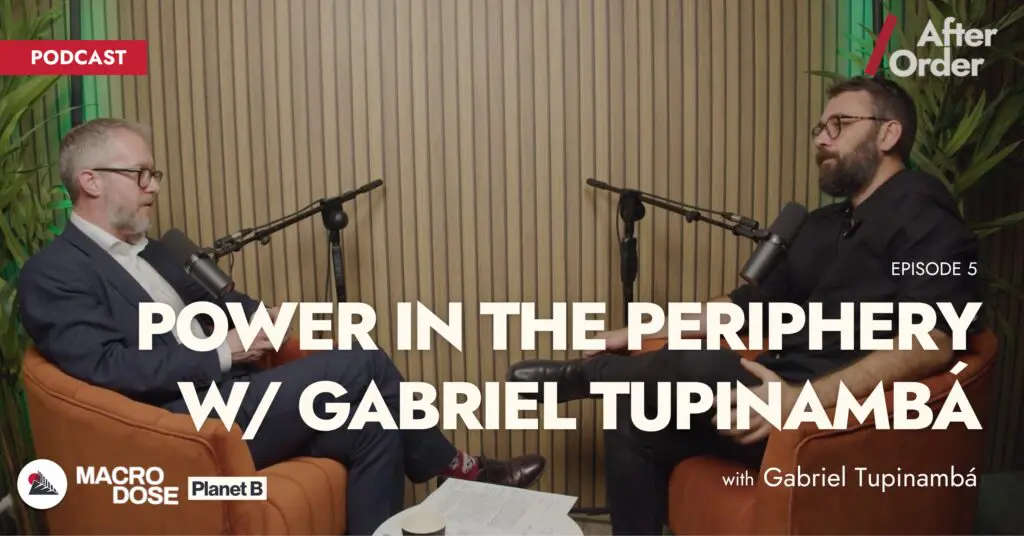
In the fifth episode of After Order — a podcast series by Alameda in collaboration with Macrodose — the focus turns to the question of popular sovereignty.
At a moment when states appear increasingly unable to guarantee rights, stability, or even the basic conditions of life, the conversation asks what it means for movements, communities and working people to build power for themselves.
Host James Meadway is joined by Gabriel Tupinambá, Senior Researcher at the Alameda, whose work examines how social movements, particularly in Brazil, are attempting to reclaim sovereignty under changing political and economic conditions.
Drawing on his forthcoming paper, Popular Sovereignties Under Peripheral Conditions, Gabriel reflects on how gains that once appeared secure — from access to land to political representation — are becoming increasingly fragile, as right-wing forces reorganise both within and beyond the state.
The discussion also raises a broader question: what does it mean to rethink sovereignty from the ground up?
Rather than treating sovereignty as a purely juridical status or a national project, Gabriel reframes it in more material terms — as the conditions that make life possible: food, land, shelter, and social reproduction. From this perspective, sovereignty is no longer the outcome of politics, but one of its essential foundations .
In a world “after order”, where instability is no longer exceptional but structural, this shift opens up a series of urgent questions:
- How durable were past political settlements?,
- Are conditions once associated with the global periphery becoming more widespread?,
- And what kinds of political alternatives can truly endure under these changing conditions?
You can listen on Spotify or watch on YouTube.

 English (UK)
  Português do Brasil