
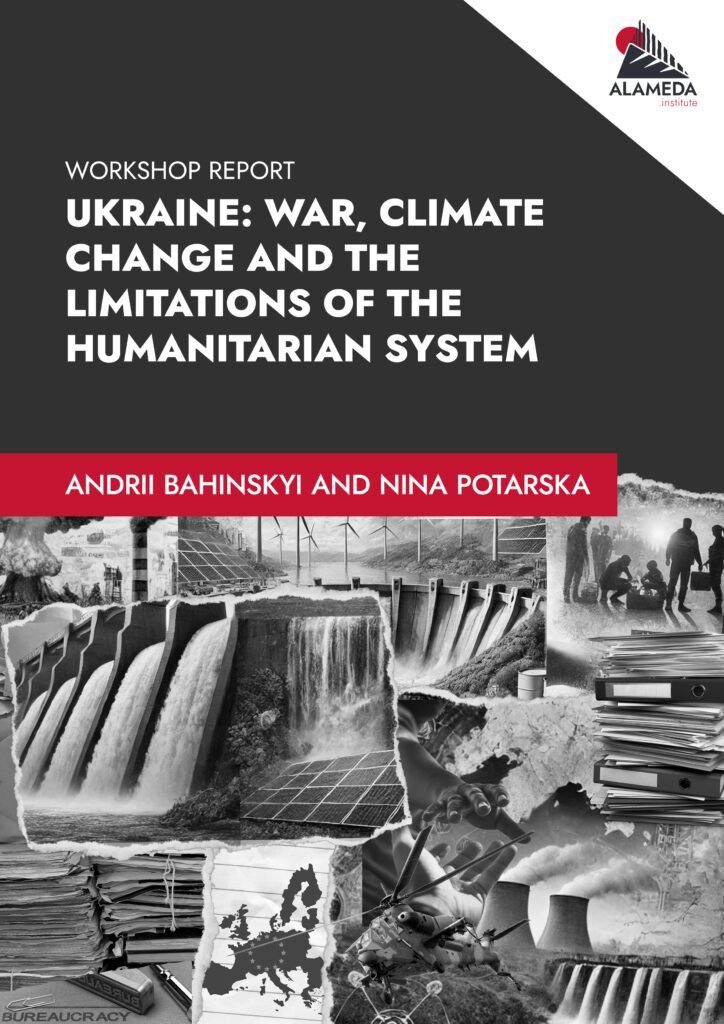
Ukraine: war, climate change and the limitations of the humanitarian system

by Andrii Bahinskyi and Nina Potarska

The war in Ukraine has triggered a profound humanitarian and environmental crisis, exposing the deep interconnections between armed conflict, ecological destruction, and global food insecurity. In their latest report, Andrii Bahinskyi and Nina Potarska analyse how war-induced CO₂ emissions, ecosystem devastation, and the disruption of critical agricultural production have created new vulnerabilities, affecting millions within and beyond Ukraine’s borders. The study also critiques the rigid structures of international humanitarian aid, which often arrive with prepackaged solutions that fail to adapt to the realities on the ground.

This publication is part of Alameda Institute’s project, “The Limits of Humanitarianism: Politics, Crisis, and Reform in the Era of Climate Change.” By examining Ukraine as a case study, we highlight the urgent need to rethink humanitarian response in an era where crises are increasingly shaped by climate breakdown and political instability. How can humanitarian systems move beyond outdated models to become more responsive, locally driven, and climate-conscious? Explore the report and join the conversation.


Andrii Bahinskyi-Nina Potarska

Andrii Bahinskyi and Nina Potarska

Andrii Bahinskyi is Associate Professor at Igor Sikorsky KPI Sociology Department (Kyiv, Ukraine) and coordinator of the master's program "Conflict Resolution and Mediation". As part of the project supported by the embassies of Great Britain and Switzerland in Ukraine, he is one of the developers of the first master's program in Ukraine, which trains specialists in the field of resolution of socio-political conflicts. Bahinskyi explores liberal peacebuilding from a global perspective. His research focuses on finding strategic solutions to resolve armed conflicts.

Nina Potarska is a gender expert on peacebuilding and conflict resolution. Since 2016, she has been the national coordinator of the International Women's League for Peace and Freedom in Ukraine. As part of her activities, she monitors the needs and observance of the rights of women living near the contact line, gender-based violence and conflict-related violence, gender-inclusive mediation in conflicts, and prepares reports on the observance of women's rights in the UN system. Since 2013, she has been the director of the Center for Social and Labor Research, and since 2015, she has been researching topics related to the war in Ukraine. She collects narratives and conducts research on both sides of the contact line. Nina is a research fellow at Alameda.

RELATED ARTICLES

Who Really Runs Brazil?

As the state fragments, Lula’s assertions of national sovereignty have exposed the limits of his government’s power, writes Juliano Fiori. ___ This article, ‘Brazil’s sovereignty’ was published in New Internationalist. July 2, 2026 ___ ‘We cannot be scared, nervous and…

Is Burnhamism about restoring sovereignty?

This article is published in full in The New Statesman and is part of Alameda’s After Order project June 25, 2026 Beneath the slogans and nicknames, Burnham is promising a radical, regionalist agenda If you wanted to design a drinking…

About Alameda Institute

June 17, 2026 Alameda is an international institute established in response to the catastrophic threats facing humanity today, including ecological collapse, large-scale war, and deepening social and economic disintegration. Working with an international network of researchers, intellectuals, activists, practitioners, and…