Who controls the infrastructure of the digital world — and what does that mean for sovereignty?
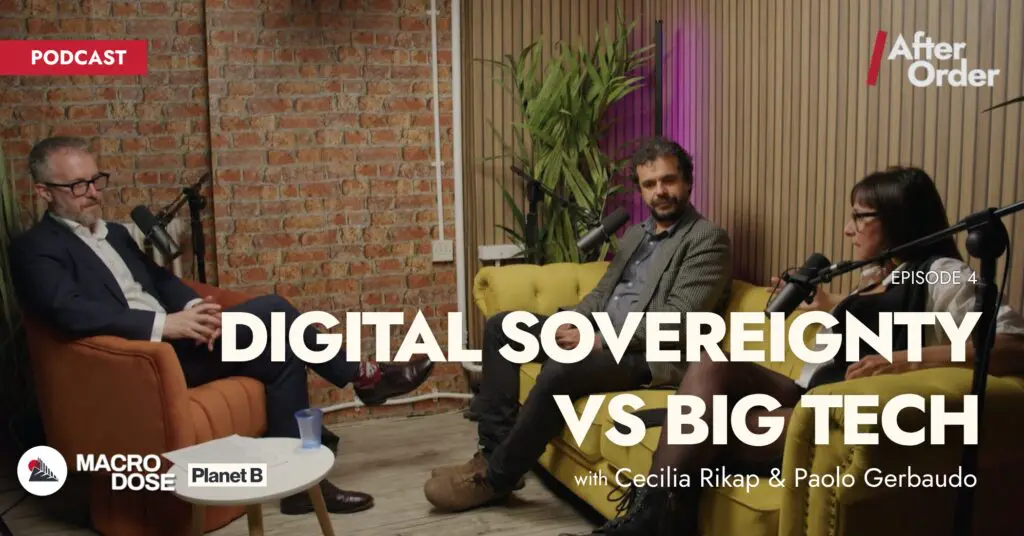
In the fourth episode of After Order — a podcast series by Alameda in collaboration with Macrodose — the focus turns to digital sovereignty following the rise of Big Tech.
From search and cloud computing to communication and logistics platforms, the systems that underpin everyday life are increasingly owned and governed by a small number of powerful corporations. That raises some big questions: What does this concentration of control mean for democracy, for states, and for the possibility of political autonomy in the digital age?
Host James Meadway is joined by Cecilia Rikap and Paolo Gerbaudo to explore these questions. Drawing on their report Reclaiming Digital Sovereignty: A Roadmap to Build a Digital Stack for People and the Planet, they talk through their vision for a digital infrastructure as a public good which is democratically governed, ecologically sustainable, and oriented towards social need, rather than private profit.
A key point that comes through in their conversation is that digital infrastructure is not just technical — it is also geopolitical. From the dominance of US Big Tech to the rise of Chinese platform ecosystems, control over data, computation and networks has become a key terrain of global power.
So if sovereignty is increasingly exercised through platforms and protocols, what would it take to reclaim digital infrastructure — and to adopt other technologies that actually serve the public interest?
In a world after order, where crises are not interruptions but enduring conditions, the stakes of these questions continue to grow.
You can listen on Spotify or watch on YouTube.
 English (UK)
 Português do Brasil